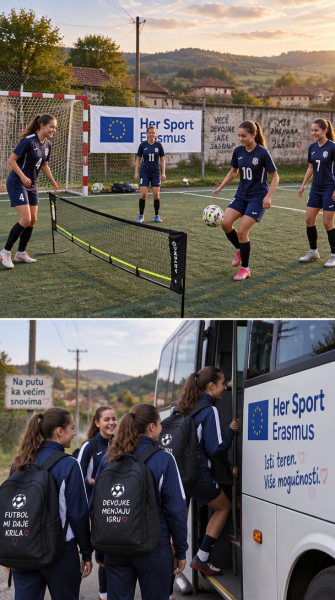
Comparison of the Family Manual’s Theoretical Goals and Real Field Results (Niš, Aleksinac, Lazarevac, Vrčin)
1. INTRODUCTION AND METHODOLOGICAL FRAMEWORK
The “HER SPORT” project (Bridging the Gap: Equal Opportunities for Girls in Sport) was created as a European response to the financial, geographical, and social barriers faced by girls aged 13 to 17. The Family Manual sets the theoretical foundation: sport is not just a physical activity, but a powerful tool for building self-confidence, inclusion, and personal development during the sensitive period of adolescence.
To verify the success of these postulates in practice, a survey was conducted on a sample of 211 girls from rural areas (surroundings of Niš, Aleksinac, Lazarevac, and Vrčin) who live in places with no public transport, and whose parents’ fuel costs were covered by the project. This analysis directly contrasts the goals from the manual with tangible field results through four key pillars of support.
2. COMPARATIVE OVERVIEW: THEORY (MANUAL) vs. PRACTICE (FIELD)
|
Analysis Area |
What the Manual Predicts (Theory) |
What the Survey Results Showed (Practice) |
|---|---|---|
|
Primary Goal & Obstacles |
Removing geographical barriers for girls from rural and remote areas through practical support (transportation). |
Logistics was the biggest enemy: As many as 78% of the girls seriously considered quitting sport before the intervention, solely due to the inability to attend training sessions. |
|
Significance of Intervention |
Supporting families to overcome obstacles in order to create equal opportunities for girls. |
Covering fuel costs was “crucial” or “very important” for 94% of the girls to continue their sports careers at all. |
|
Mental Well-being |
Reducing stress, anxiety, and managing pressures at school, during puberty, and at home. |
33% of the girls use sport as a mechanism to combat stress, while 85% feel immense relief and happiness because they no longer have to choose between school and sport. |
|
Confidence & Vision |
Building self-belief and empowering girls to achieve goals on the field and in life. |
42% of the girls state that sport builds their confidence and belief that they can achieve anything in life. |
|
Social Inclusion |
Fostering community participation, connection, and escaping isolation. |
32% of the girls view their team as a “second family”, and 15% use sport as a direct escape from boredom and rural isolation. |
|
Long-term Sustainability |
Developing healthy routines so girls remain active in the sports community into adulthood. |
High awareness: the average score of sport’s importance is 9.3 / 10, and 91% of the girls plan to remain active when they grow up. |
3. DEEP DIVE INTO KEY PILLARS OF SUPPORT
Pillar A: Geographical Isolation and Logistics as the Enemies of Talent
The manual correctly identifies rural areas as high-risk for early sports dropout. However, the data showing that 78% of girls were on the verge of quitting proves that without systemic logistical support, talent in villages stands no chance of survival. Solving the transportation issue had a profound emotional effect, as confirmed by 16-year-old Marija: “I thought I had to give up because my dad couldn’t spend money on fuel every day, and there are no buses. When the project solved that for us, my will to live returned, not just my will for sport.”
Pillar B: The Role of Parents – From Financial Burden to Active Allies
The manual is primarily designed to guide and unburden parents without judgment. In practice, the role of parents transformed from passive (inability to finance daily transport) to active. Once the project covered fuel costs, parents invested their time and became direct partners in their children’s sports development. The result is a dramatic drop in intra-family pressure: 85% of the girls felt “immense relief and gratitude” because they were freed from the guilt of being a financial burden to their parents. Sport ceased to be a luxury and became an integrated part of family daily life.
Pillar C: The Role of Coaches – Mentors, Educators, and Creators of Safe Spaces
The manual provides for special training for coaches to create safe, inclusive, and encouraging opportunities for girls. Statistical results show that the coaches on the ground excelled in their pedagogical and mentoring roles:
-
Building Intrinsic Motivation: Coaches successfully shifted the focus from the dry pursuit of results to a pure love of the game. That is why 48% of the girls cite love for the game and a sense of achievement as their primary motivation, rather than the pressure to win.
-
Prevention and Educational Work: Through discipline and clear organization of training sessions implemented by coaches, sport became a shield against deviant behaviors. The fact that none of the surveyed girls smoke, and only 2% have tried alcohol, is a direct credit to the coaches who created a healthy micro-environment.
-
Focus on Life Skills: An impressive 88% of the girls emphasize that the skills taught by their coaches (perseverance, teamwork, respect) are more important for their future careers than the sports results themselves. The coach is recognized here as a life mentor, not just a technical expert.
4. CONCLUSION
The analysis clearly shows that the “HER SPORT” project successfully translates the theory from the manual into a tangible and transformative reality. The integrated chain of support – where the project provides resources, parents handle logistics, and coaches provide professional and pedagogical work – has created an impenetrable shield around girls during the critical adolescent age.
Statistics and testimonials from the stations around Niš, Aleksinac, Lazarevac, and Vrčin send a powerful message: twenty liters of fuel and an educated coach do not just save a sports career – they save mental health, build character, and pave the way for a successful future for young women.
“Funded by the European Union. Views and opinions expressed are however those of the author(s) only and do not necessarily reflect those of the European Union or the European Education and Culture Executive Agency (EACEA). Neither the European Union nor the granting authority can be held responsible for them.”